Bombing of Japan in World War II
Doolittle Raid[edit]
The Doolittle Raid was a bomber raid launched on the Japanese mainland on April 18, 1942. The raid — largely a propaganda and morale-building exercise — was planned and led by then Lieutenant Colonel James Harold Doolittle. The raid was made possible by a technical observation of Captain Francis Low that twin-engined bombers could be launched from an aircraft carrier. Subsequent tests appeared to prove that a B-25 Mitchell could be launched with a reasonable bomb load, hit targets in Japan and then fly on to land in China.
Ships and airplanes[edit]

Apr. 18, :en:1942 - Army Lieut. Col. Doolittle, taking off from :en:USS Hornet (CV 8), bombed Tokyo.
%2c_circa_in_late_1941_(NH_81313).jpg/120px-Aft_view_of_USS_Hornet_(CV-8)%2c_circa_in_late_1941_(NH_81313).jpg)
US Aircraft Carrier USS Hornet (CV-8)
US Aircraft Carrier USS Hornet (CV-8) during Doolittle Raid

B-25 prior to start on USS Hornet for Doolittle raid
.jpg/120px-Army_B-25_(Doolittle_Raid).jpg)
Take off from the deck of the USS HORNET of an Army B-25 on its way to take part in first U.S. air raid on Japan. Doolittle Raid, April 1942

B-25 on the flight deck of USS Hornet
_launching_B-25B_bomber_during/120px-USS_Hornet_(CV-8)_launching_B-25B_bomber_during_the_Doolittle_Raid_on_18_April_1942_(80-G-41197).10841)
The Raid[edit]
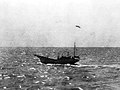
Japanese fishing boat which was sunk by Major General Doolittles raiders while enroute to Tokyo for the raid on April 18, 1942
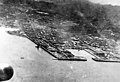
Major General James Doolittle’s raid on Tokyo. Flying over Yokosuka Japan Naval base. Photo taken from B-25, April 18, 1942
The Raiders in China[edit]

Wreckage of Major General James Doolittle’s plane in China after the raid on Tokyo

Chinese carry Doolittle's raiders to safety

Doolittle’s men require air raid shelter too. Major General James Doolittle’s Tokyo raiders are grouped outside this shelter carved from the mountainside. They lived here for 10 days after assembling from their Chinese mountain retreats. Japanese planes raided nearby villages frequently

Major General Doolittle, his Tokyo bombing crew and some Chinese friends are pictured in China after the US Airmen bailed out following the Doolittle led air raid on Japan
People[edit]

James H. Doolittle wires Japanese (peace) medals to a bomb.
Conventional B-29[edit]

B-29s drop bombs on a Japanese city
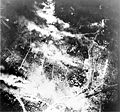
Tokyo burns after a firebomb attack
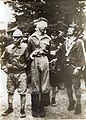
A captured American survivor of a shot-down B-29 crew is led from a village hall in Niigata, Japan in July, 1945.
Atomic[edit]
Development of the weapons: See Category:Manhattan Project
Results of the weapons: See Category:Hiroshima in ruins and Category:Nagasaki in ruins
Hiroshima[edit]

Locations of the two atomic bombings

Left to right: Major Thomas W. Ferebee, Bombardier; Col. Paul W. Tibbets, Jr. Pilot; Capt. Theodore J. Van Kirk, Navigator; and Captain Robert Lewis, officer crew of the Enola Gay, the ship that made the historic flight over Hiroshima to drop the first atomic bomb

At the briefing prior to flight of the Enola Gay, Capt. William Sterling Parsons and Col. Tibbets go over last minute data

"Enola Gay" and its crew

Little Boy, a nuclear weapon

Atomic bombing
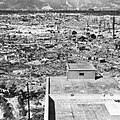
Destruction of Hiroshima
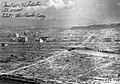
Hiroshima aftermath
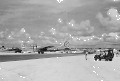
B-29 "Enola Gay" after strike, 08/06/1945.
Nagasaki[edit]
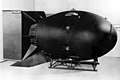
Fat Man, a nuclear weapon
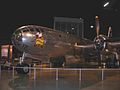
Bockscar dropped Fat Man on Nagasaki
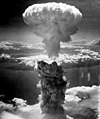
Atomic bombing
.jpg/110px-Nagasaki_1945_-_Before_and_after_(adjusted).jpg)
before and after atomic bombing
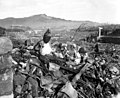
September 24, 1945
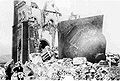
Urakami Tenshudo after bombing

0ne-legged torii, Sannō Shrine, The other half was toppled in the explosion of the nuclear
Other[edit]
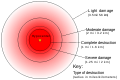
Estimated damage